What is Lorem Ipsum Text?
Lorem ipsum text is placeholder content derived from a 45 BC philosophical work by Cicero called De Finibus Bonorum et Malorum. It has been used by typesetters and designers since the 1500s because its letter distribution closely mirrors natural English, making it ideal for previewing layouts without readable content distracting from the design.
If you have ever built a UI, tested a database schema, or prototyped a landing page, you have used lorem ipsum text. Most developers treat it as a meaningless block of fake Latin they grab from the first Google result. But lorem ipsum is not random gibberish. It is a deliberately scrambled passage from one of the most important works of Roman philosophy, and understanding what it actually says, where it comes from, and how to use it properly makes you better at the tasks you use it for.
This guide covers the full original passage, a line-by-line translation, ready-to-copy blocks at various lengths, developer-specific use cases, and the privacy implications of grabbing placeholder text from online tools.
Table of contents
- The full standard lorem ipsum text
- What lorem ipsum text actually means
- The history: from Cicero to your codebase
- Ready-to-copy lorem ipsum blocks
- How developers actually use lorem ipsum text
- Why the letter distribution matters
- Greeking: the industry term you should know
- The privacy problem with online generators
- Frequently asked questions
The full standard lorem ipsum text
The standard lorem ipsum passage is the most widely reproduced block of text in the history of publishing. It consists of five sections that map to Cicero's original Latin, though the words have been scrambled, truncated, and rearranged over five centuries of copying.
Here is the full text as standardized by the typesetting industry:
Lorem ipsum dolor sit amet, consectetur adipiscing elit, sed do eiusmod tempor incididunt ut labore et dolore magna aliqua. Ut enim ad minim veniam, quis nostrud exercitation ullamco laboris nisi ut aliquip ex ea commodo consequat. Duis aute irure dolor in reprehenderit in voluptate velit esse cillum dolore eu fugiat nulla pariatur. Excepteur sint occaecat cupidatat non proident, sunt in culpa qui officia deserunt mollit anim id est laborum.
That is 69 words and 446 characters. This single paragraph is what most people mean when they say "the lorem ipsum text."
But there is more. The extended version, used in type specimen books and longer layout previews, includes several additional paragraphs drawn from sections 1.10.32 and 1.10.33 of De Finibus Bonorum et Malorum:
Sed ut perspiciatis unde omnis iste natus error sit voluptatem accusantium doloremque laudantium, totam rem aperiam, eaque ipsa quae ab illo inventore veritatis et quasi architecto beatae vitae dicta sunt explicabo. Nemo enim ipsam voluptatem quia voluptas sit aspernatur aut odit aut fugit, sed quia consequuntur magni dolores eos qui ratione voluptatem sequi nesciunt. Neque porro quisquam est, qui dolorem ipsum quia dolor sit amet, consectetur, adipisci velit, sed quia non numquam eius modi tempora incidunt ut labore et dolore magnam aliquam quaerat voluptatem.
This second block is closer to Cicero's original and is actually more grammatically correct Latin than the first paragraph.
What lorem ipsum text actually means
The phrase "lorem ipsum" is a truncation of "dolorem ipsum," which translates to "pain itself" in Latin. The full opening line, when reconstructed from Cicero's original, reads:
Latin: "Neque porro quisquam est, qui dolorem ipsum quia dolor sit amet, consectetur, adipisci velit..."
English: "Nor is there anyone who loves or pursues or desires to obtain pain itself, because it is pain, but because occasionally circumstances occur in which toil and pain can procure some great pleasure."
Cicero was presenting and critiquing Epicurean philosophy, the idea that pleasure is the highest good and pain is the greatest evil. His argument was nuanced: sometimes you must accept pain to achieve a greater pleasure, and sometimes you must refuse pleasure to avoid greater future pain.
Here is a section-by-section breakdown of the extended passage:
| Lorem Ipsum Section | Cicero's Original Meaning |
|---|---|
| "Lorem ipsum dolor sit amet, consectetur adipiscing elit" | "Pain itself, because it is pain, let him love it, pursue it, desire it" |
| "sed do eiusmod tempor incididunt ut labore et dolore magna aliqua" | "but because occasionally circumstances occur in which toil and pain can procure some great pleasure" |
| "Ut enim ad minim veniam" | "For, to take a trivial example" |
| "quis nostrud exercitation ullamco laboris" | "which of us ever undertakes laborious physical exercise" |
| "Duis aute irure dolor in reprehenderit" | "But who has any right to find fault with a man who chooses to enjoy a pleasure" |
| "Excepteur sint occaecat cupidatat non proident" | "except to obtain some advantage from it" |
The irony is hard to miss. A philosophical treatise about the nature of pleasure and pain became the world's most ignored piece of writing.
The history: from Cicero to your codebase
Lorem ipsum text has a traceable lineage spanning over two thousand years. Here are the key dates:
45 BC. Marcus Tullius Cicero writes De Finibus Bonorum et Malorum, a five-book philosophical work examining Epicurean, Stoic, and Peripatetic theories of ethics. Sections 1.10.32 and 1.10.33 contain the source passage.
~1500s. An unknown printer scrambles the Cicero passage to create a type specimen book. The scrambling was intentional. By breaking the Latin into nonsensical fragments, the printer ensured that readers would focus on the typeface rather than the content. The text spread through the European printing industry.
1960s. Letraset, a company that manufactured dry-transfer lettering sheets, includes lorem ipsum text on their products. Designers and typesetters worldwide begin using it as a standard placeholder. The passage becomes embedded in the visual design industry.
1985. Aldus Corporation releases PageMaker, one of the first desktop publishing applications. Lorem ipsum is included as default placeholder text. This is the moment the text enters the digital world.
~1982. Richard McClintock, a Latin scholar at Hampden-Sydney College, traces the origin of lorem ipsum by searching for uses of the rare Latin word consectetur. His research confirms the connection to Cicero's De Finibus.
1990s-present. Content management systems (WordPress, Joomla), design tools (Figma, Sketch), and development frameworks adopt lorem ipsum as default placeholder text. It becomes the most widely used dummy text in the world.
Ready-to-copy lorem ipsum blocks
Different tasks require different amounts of text. Here are pre-sized blocks you can copy directly.
One sentence
Lorem ipsum dolor sit amet, consectetur adipiscing elit, sed do eiusmod tempor incididunt ut labore et dolore magna aliqua.
Use for: form field placeholders, card subtitles, tooltip previews.
One paragraph (standard)
Lorem ipsum dolor sit amet, consectetur adipiscing elit, sed do eiusmod tempor incididunt ut labore et dolore magna aliqua. Ut enim ad minim veniam, quis nostrud exercitation ullamco laboris nisi ut aliquip ex ea commodo consequat. Duis aute irure dolor in reprehenderit in voluptate velit esse cillum dolore eu fugiat nulla pariatur. Excepteur sint occaecat cupidatat non proident, sunt in culpa qui officia deserunt mollit anim id est laborum.
Use for: blog post previews, product descriptions, single-section layouts.
Three paragraphs
Lorem ipsum dolor sit amet, consectetur adipiscing elit, sed do eiusmod tempor incididunt ut labore et dolore magna aliqua. Ut enim ad minim veniam, quis nostrud exercitation ullamco laboris nisi ut aliquip ex ea commodo consequat. Duis aute irure dolor in reprehenderit in voluptate velit esse cillum dolore eu fugiat nulla pariatur. Excepteur sint occaecat cupidatat non proident, sunt in culpa qui officia deserunt mollit anim id est laborum.
Sed ut perspiciatis unde omnis iste natus error sit voluptatem accusantium doloremque laudantium, totam rem aperiam, eaque ipsa quae ab illo inventore veritatis et quasi architecto beatae vitae dicta sunt explicabo. Nemo enim ipsam voluptatem quia voluptas sit aspernatur aut odit aut fugit, sed quia consequuntur magni dolores eos qui ratione voluptatem sequi nesciunt.
Neque porro quisquam est, qui dolorem ipsum quia dolor sit amet, consectetur, adipisci velit, sed quia non numquam eius modi tempora incidunt ut labore et dolore magnam aliquam quaerat voluptatem. Ut enim ad minima veniam, quis nostrum exercitationem ullam corporis suscipit laboriosam, nisi ut aliquid ex ea commodi consequatur.
Use for: article layouts, multi-section pages, email template testing.
Five paragraphs
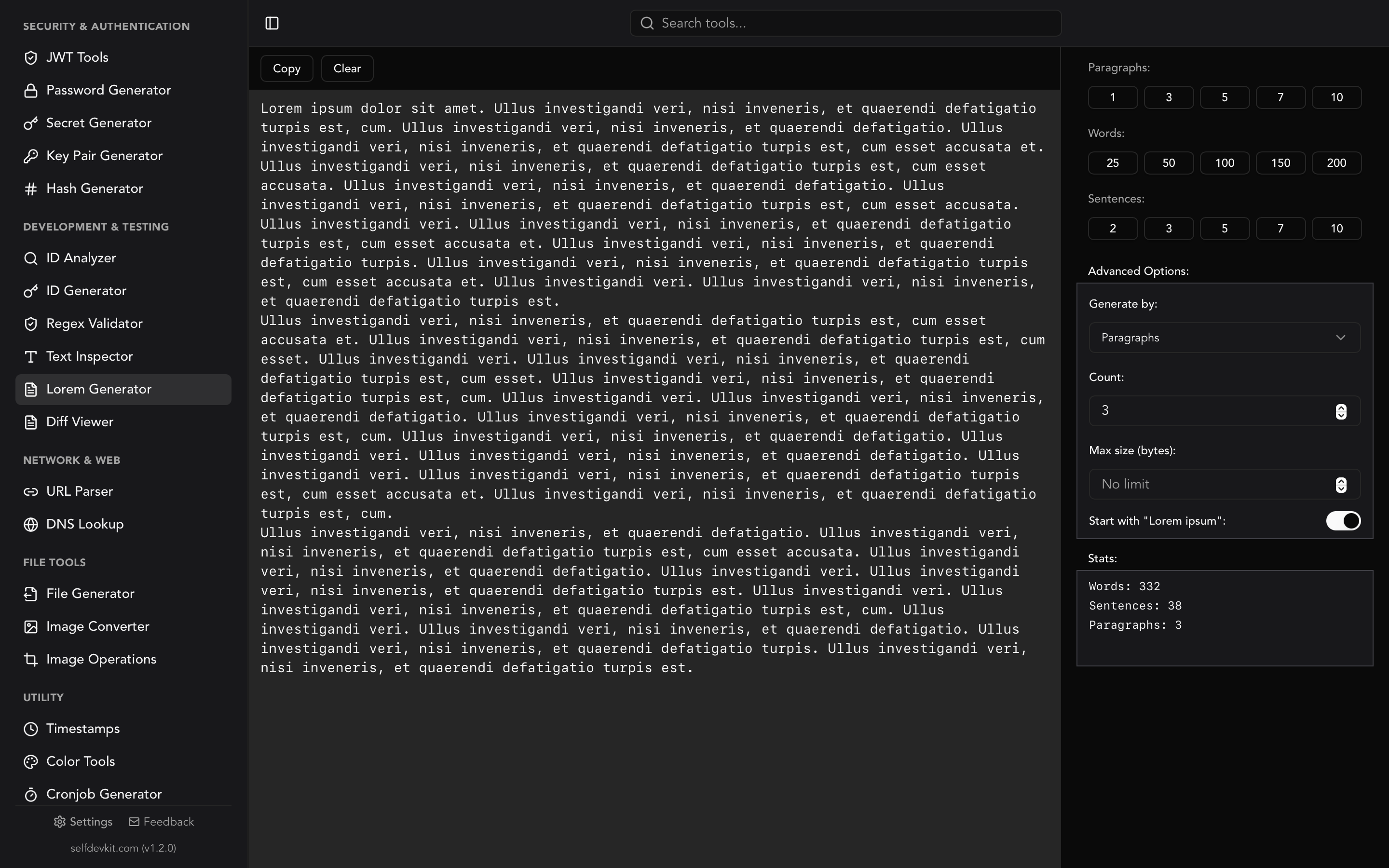
For longer layouts, five paragraphs covers most full-page design needs. Rather than reproducing them all here, use SelfDevKit's Lorem Generator to generate exactly the amount you need with precise word counts, sentence counts, or character limits.
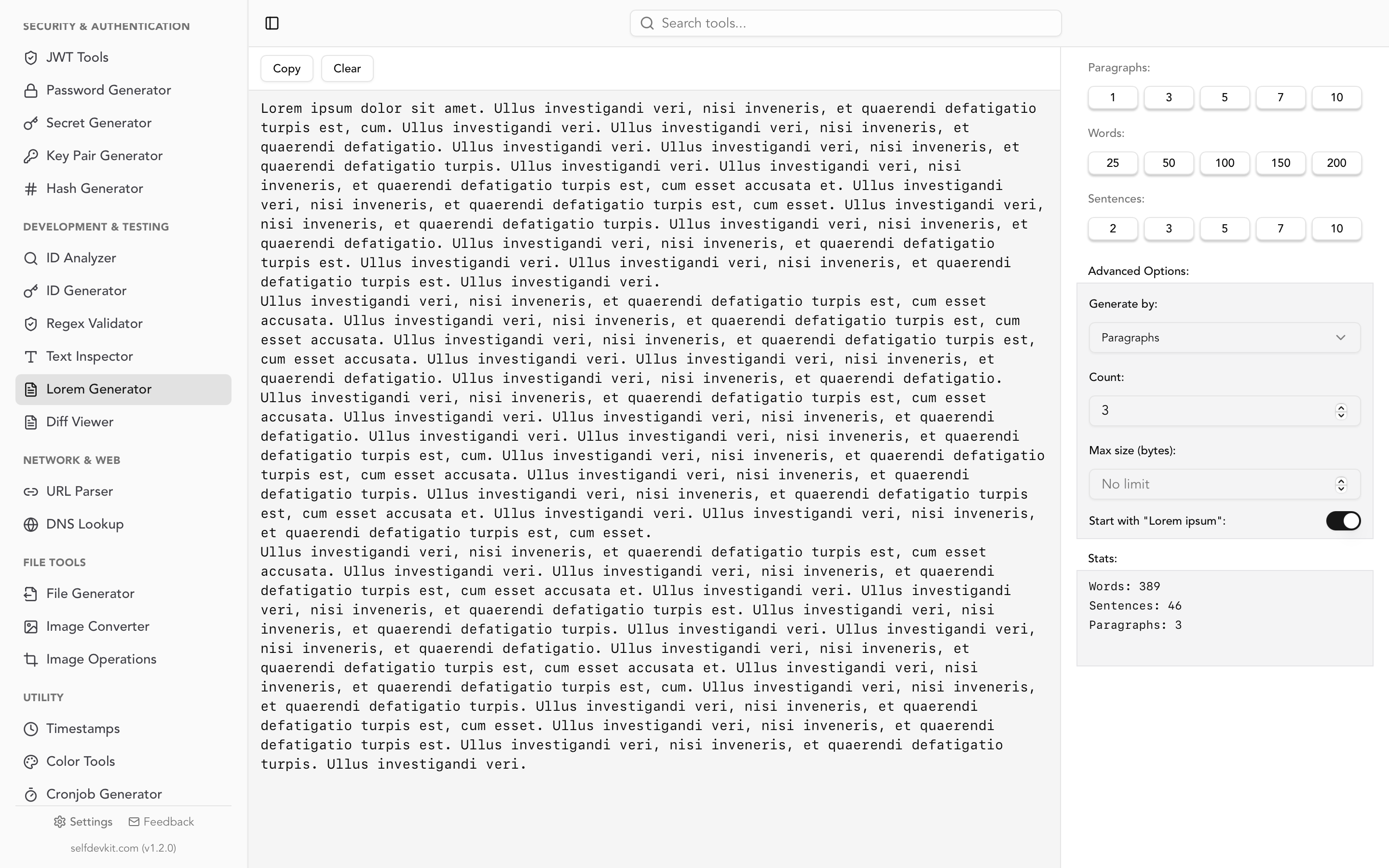
If you need custom lengths frequently, our lorem ipsum generator guide covers code examples for generating text programmatically in JavaScript, Python, Rust, and Go.
How developers actually use lorem ipsum text
Placeholder text serves a broader purpose in software development than most articles acknowledge. Lorem ipsum text is not just for designers filling Figma mockups. Developers use it throughout the entire development lifecycle.
UI component testing
When building a card component, a table cell, or a notification banner, you need to verify that the layout handles varying content lengths. A three-word title behaves differently from a twelve-word one. Lorem ipsum text at controlled lengths exposes overflow bugs, truncation issues, and CSS wrapping problems that "test content" never catches.
// Test your component with different lorem ipsum lengths
const testCases = [
  { title: 'Lorem ipsum', body: 'Dolor sit amet.' },
  { title: 'Lorem ipsum dolor sit amet consectetur', body: 'Sed do eiusmod tempor incididunt ut labore et dolore magna aliqua. Ut enim ad minim veniam, quis nostrud exercitation ullamco laboris nisi ut aliquip ex ea commodo consequat.' },
  { title: 'L', body: 'Lorem ipsum dolor sit amet, consectetur adipiscing elit, sed do eiusmod tempor incididunt ut labore et dolore magna aliqua. Ut enim ad minim veniam.' }
];
Database seeding
Development databases need realistic-looking content. A column filled with "test test test" tells you nothing about query performance or how your ORM handles real-world string lengths. Lorem ipsum provides varied word and sentence lengths that closely mimic actual user content.
INSERT INTO posts (title, body, status, created_at)
VALUES
  ('Lorem ipsum dolor sit amet',
   'Consectetur adipiscing elit, sed do eiusmod tempor incididunt ut labore et dolore magna aliqua.',
   'published', NOW()),
  ('Sed ut perspiciatis unde omnis',
   'Nemo enim ipsam voluptatem quia voluptas sit aspernatur aut odit aut fugit.',
   'draft', NOW());
SelfDevKit's SQL tools can format those INSERT statements for readability as your seed files grow.
API mock responses
When the backend is not ready, frontend developers mock API responses. Lorem ipsum text in mock data reveals UI problems that placeholder text like "string" or "content here" cannot.
{
  "articles": [
    {
      "id": "550e8400-e29b-41d4-a716-446655440000",
      "title": "Lorem ipsum dolor sit amet",
      "excerpt": "Consectetur adipiscing elit, sed do eiusmod tempor...",
      "body": "Ut enim ad minim veniam, quis nostrud exercitation ullamco laboris nisi ut aliquip ex ea commodo consequat.",
      "author": "Cicero",
      "publishedAt": "2026-05-28T10:00:00Z"
    }
  ]
}
Validate your mock JSON with SelfDevKit's JSON tools to catch syntax errors before they waste debugging time. For generating those UUIDs alongside your placeholder text, the ID Generator handles UUIDs, ULIDs, and NanoIDs.
Email template testing
Email clients render HTML inconsistently. Gmail strips certain CSS. Outlook ignores others entirely. Testing with lorem ipsum paragraphs at varying lengths helps verify that your email layout survives every client. Preview the HTML output with SelfDevKit's HTML Viewer before sending test emails.
Why the letter distribution matters
Lorem ipsum text is not just random Latin words thrown together. Its letter frequency distribution closely mirrors real English text, which is exactly why it has survived for five centuries while other placeholder approaches have not.
| Letter | Lorem Ipsum | English |
|---|---|---|
| e | ~11.8% | ~12.7% |
| t | ~8.2% | ~9.1% |
| a | ~8.1% | ~8.2% |
| i | ~7.5% | ~7.0% |
| o | ~6.8% | ~7.5% |
| n | ~6.1% | ~6.7% |
The word length distribution matters even more. Lorem ipsum averages 5.1 characters per word, compared to English at 4.7. This means your UI components will wrap, break, and overflow in patterns that closely match what real content will produce.
Compare that to placeholder text like "The quick brown fox jumps over the lazy dog" (avg 3.9 chars/word) or "Content goes here content goes here" (avg 4.8 chars/word but with zero length variation). Neither produces realistic line breaks. Lorem ipsum does.
This is why "just use real English filler" is bad advice for layout testing. Real English filler carries semantic meaning that distracts reviewers from evaluating the visual design. And unless you carefully construct it, the word length distribution will not match what actual users write.
Greeking: the industry term you should know
The practice of using placeholder text in layouts is called "greeking." The term comes from the phrase "it's Greek to me," meaning the text is intentionally unreadable. According to Britannica, the technique predates digital design entirely. Typesetters in the pre-digital era used Greek or scrambled Latin text in galley proofs to demonstrate typeface samples without the distraction of readable content.
In modern usage, "greeking" extends beyond text. Designers also "greek" images (using gray boxes) and data (using placeholder numbers) during early prototyping phases. But lorem ipsum remains the dominant form.
You will sometimes see "greek text" and "dummy text" used interchangeably with "lorem ipsum text." They are not exactly the same. Greek text refers to any unreadable placeholder. Dummy text refers to any non-final content. Lorem ipsum is a specific dummy text with a specific origin.
The privacy problem with online generators
Most developers grab lorem ipsum text from whatever website appears first in search results. This seems harmless. It is just placeholder text.
But consider how you actually use these tools. You do not visit a lorem ipsum site in isolation. You are mid-workflow, with tabs open to your project code, your database admin panel, and your design tool. The lorem ipsum site you visit loads third-party analytics scripts, ad trackers, and social widgets. These scripts can see your browsing context, read referrer headers, and fingerprint your browser.
Worse, some generators ask you to configure parameters: field names, content types, data structures. This metadata hints at your project's architecture, feature set, or even unreleased product plans.
The straightforward solution: use an offline generator. SelfDevKit's Lorem Generator runs entirely on your machine. No network requests, no server logs, no tracker scripts. Generate as much lorem ipsum text as you need without sharing your workflow with third parties.
This is the same principle behind using offline tools for JSON formatting and Base64 encoding. If the tool does not need a network connection to function, it should not require one.
The same logic applies to JWT decoding, SQL formatting, and every other daily developer task. Keep your workflow local.
Frequently asked questions
Is lorem ipsum text copyrighted?
No. The original source text by Cicero dates to 45 BC, placing it firmly in the public domain. The scrambled "lorem ipsum" version has been in continuous use since the 1500s. No individual or organization holds copyright over it, and you can use it freely in any project.
What does "lorem ipsum dolor sit amet" mean in English?
It translates roughly to "pain itself, because it is pain, let him love it." The phrase is a truncated and scrambled version of a sentence from Cicero's De Finibus Bonorum et Malorum (1.10.32), which discusses why people sometimes pursue pain to achieve greater pleasure. The standard lorem ipsum passage is not grammatically correct Latin; it was deliberately mangled to function as unreadable filler.
Can I use lorem ipsum text in production?
You can, but you should not. Lorem ipsum is placeholder text meant to be replaced with real content before launch. Shipping with lorem ipsum visible to users signals that your product is unfinished. Some developers add lint rules or CI checks that flag the phrase "lorem ipsum" in production templates to catch accidental deployments.
How much lorem ipsum text should I generate for testing?
Match the expected real-world content length. If your blog cards show 150-word excerpts, test with 150 words. If a user bio field caps at 500 characters, test at exactly 500 characters. Also test edge cases: an empty string, a single character, and text that far exceeds the maximum. SelfDevKit's Lorem Generator lets you specify exact word counts and set character limits. For related text analysis, the Text Inspector provides character, word, and line counts on any content.
Generate lorem ipsum text offline
SelfDevKit gives you a lorem ipsum generator with word, sentence, and paragraph modes, real-time statistics, and a max character limit. No network connection. No data shared with third parties.
Download SelfDevKit to get the lorem generator plus 50+ other developer tools, all offline and private.